
Are we at peak everything?
In the Honest Sorcerer's 2025 wrap up, the author argues that mineral and energy scarcity is leading to deindustrialisation and inflation:
- As energy and mineral resources get harder to access, more energy and material resources are needed to extract and process them, increasing costs to the point it's not economic to extract them.
- Higher prices for energy and materials lead large companies to move offshore and smaller factories to close. Unemployment rises, inequality increases, and democracy suffers as voters, left behind for the system, elect people who promise to break the system.
- Debt cannot be used to buy one's way out of this, since debt is ultimately a call on future energy and material resources and, of course, drives inflation.
- To try to keep the system running, at least domestically, some countries will take other countries' resources, which generally ends in war.
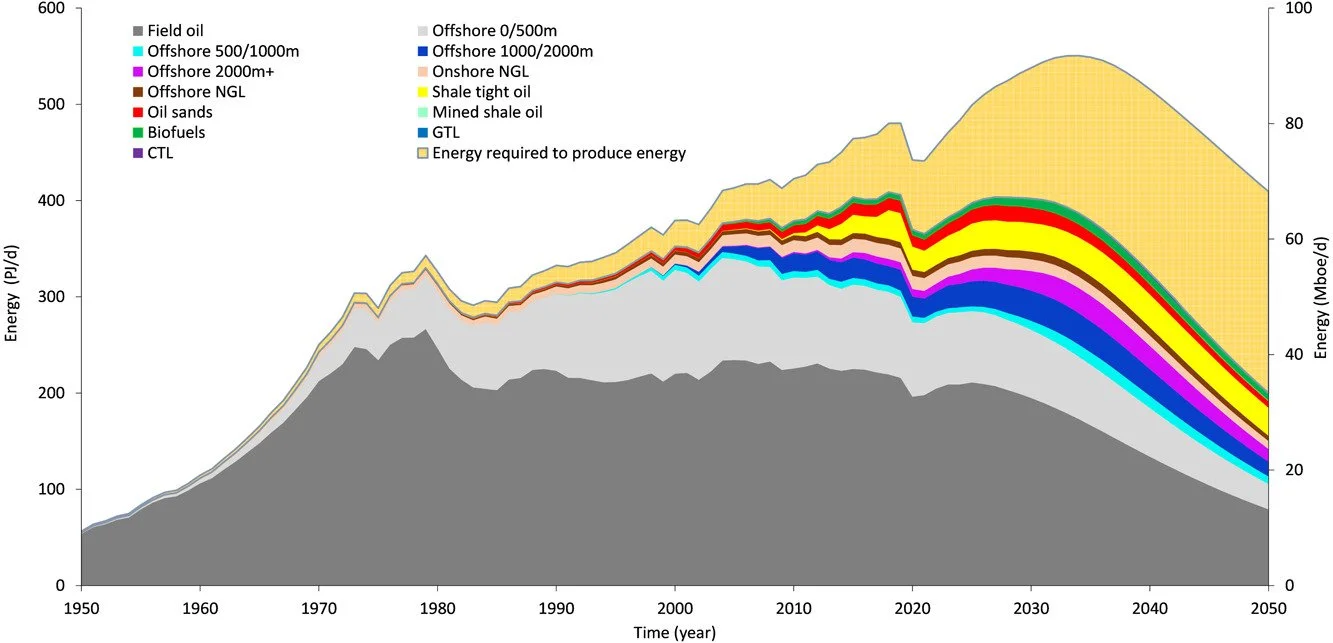
The energy required to get energy is increasing and is forecast to continue increasing.
Source: https://doi.org/10.1016/j.apenergy.2021.117843
Impacts for the built environment
- We're already seeing steel production dropping: it is yet to return to 2021 levels and is unlikely to, given the above. Other minerals critical to the modern world, like copper, are not far behind.
- We can't just electrify everything and carry on as before, because the minerals required aren't available at that scale. We need to use less.
- We need to make our existing buildings and infrastructure fit for the future, to minimise energy and materials involved in new build. This needs systemic thinking rather than discipline-specific thinking.
- Part of this is passive design of buildings (e.g., natural light, natural ventilation, thermal mass), which needs to become standard practice. Fortunately, good design can achieve this without additional cost.
- Communities need to be set up for resilience and self sufficiency because global supply chains can't be relied on long term. Most fundamentally, food production and water security needs to be integrated into both new and existing communities.
I've spent nearly 30 years working at this, but the urgency now is higher than its ever been. Change is coming due to fundamentals and it's time for our development approaches to catch up.
What strategies are you using to future‑proof your projects? Drop a comment below or send me a direct message; I’d love to continue the conversation.
