
You can't assume utilities will always be there.
On a number of recent master planning projects I've pointed out energy supply cannot be guaranteed, and that can be fatal if a lack of air conditioning coincides with a high heat index (which is increasingly likely thanks to climate change). Or even that food delivery may not be as secure as assumed, as Punmu in Western Australia is currently finding.
Until now, this has been met with disbelief that six-continent supply chains, geared for economic efficiency and so inherently fragile, could ever fail. But the current energy crisis has quickly shown that the systems we rely on can grind to a halt if one key element fails.
Primary concerns I've been highlighting on Middle Eastern projects include failure of the energy system, water network and supply chain logistics. The following is a vastly simplified map of potential failure mechanisms and consequences. As you can see, a lot can go wrong, so assuming the local government Utility will ensure supply is...optimistic. It is therefore best to be prepared.
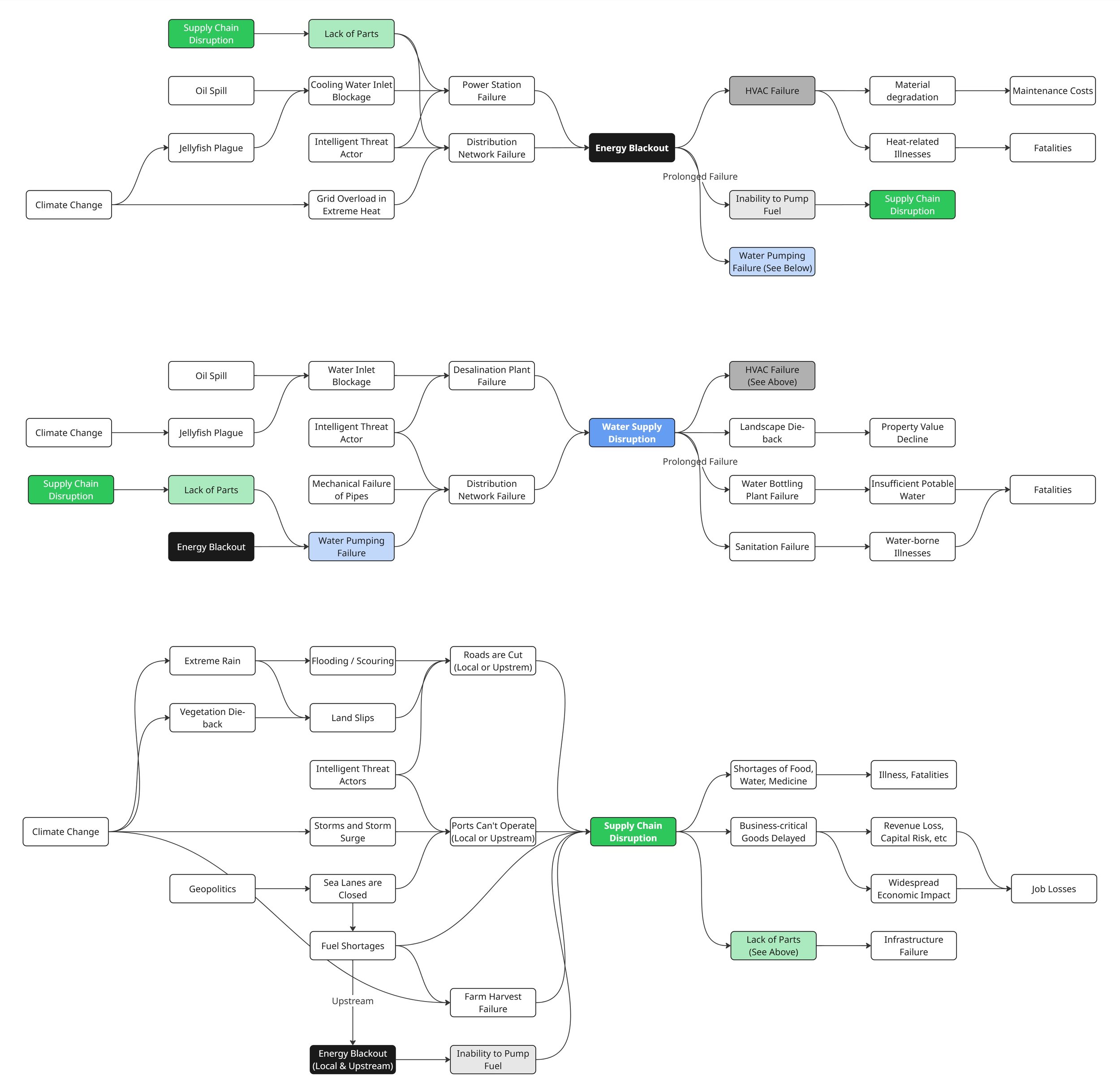
Three simplified potential risk cascades
Mapping the system like this helps suggests interventions to harden your development.
Energy blackouts. You can't do much about the national grid at the master plan level, but you can:
Include your own power sources, especially renewables that don't rely on fuel deliveries.
Use passive design strategies to reduce cooling loads and keep buildings cool without (or with reduced) HVAC capacity until systems come back up.
Water supply disruption. Again, national supply is outside your control but you can:
Buffer the supply through local holding tanks to get you through an emergency.
Include on-site treatment: the 'potable' water out of the tap in many countries is not always palatable, leading high use of botted water. Localised treatment of this can insulate from supply chain disruptions. Localised treatment of waste water is also possible, even if it's only destined for the garden.
Stockpile bottled water. With a career history in sustainability, I'm not usually pro-bottled water, but if buffering supply or local treatment are off the table for some reason, this is a practical response to getting a population through a disaster.
Supply chain disruption. Food and (bottled) water are the biggest concerns here, and point towards urban agriculture. The aim isn't 365-day, 100% supply--we have separate cities and farmland for a reason--but enough to take the edge off and get people through a disaster. This could look like:
Backyard gardens and allotments so villa and apartment residents, respectively, can grow food if they wish
Managed communal gardens focussing on heat-tolerant, energy-dense and nutrient-rich crops (e.g., date palms, sweet potatoes, legumes, with herbs and leafy greens in climate-controlled grow-houses)
Aquaponics systems for added protein.
Importantly, these responses can be combined. For example, landscaping can provide a better microclimate, lowering environmental thermal loads on buildings, while making walking more attractive. When landscaping works with site contours rather than rectilinear plot alignments, it can also help manage stormwater, reducing flood risks both onsite and downstream. Planted as a food forest, landscaping also provides food security, while green waste can be composted and worked back into the soil, reducing irrigation demand. Constructed wetlands, meanwhile, help treat water while also providing amenity, habitat (including for fish like tilapia) and microclimate benefits.
There are a lot of no-regret responses available that harden a development from climate and other shocks, while also providing tangible benefits from utilities to amenity and perceived value. The key to unlocking this is early consideration of potential failure mechanisms, coupled with an integral mindset that looks for synergies across technical disciplines, human (social) and non-human (ecological) inter-relationships, and what is of real value to the ultimate residents. Done right, capital and operational costs are reduced, the risk of asset stranding is minimised, and real long-term value is achieved.
If you have a planning project in the Middle East or elsewhere, and you would like to discuss how to make it more resilient, we would love to connect.
